
Every country must manage its available water carefully to support its people, farms, industries and natural environment. Rivers, groundwater, rainfall, stormwater, recycled water and coastal resources should be planned as parts of one coordinated system.
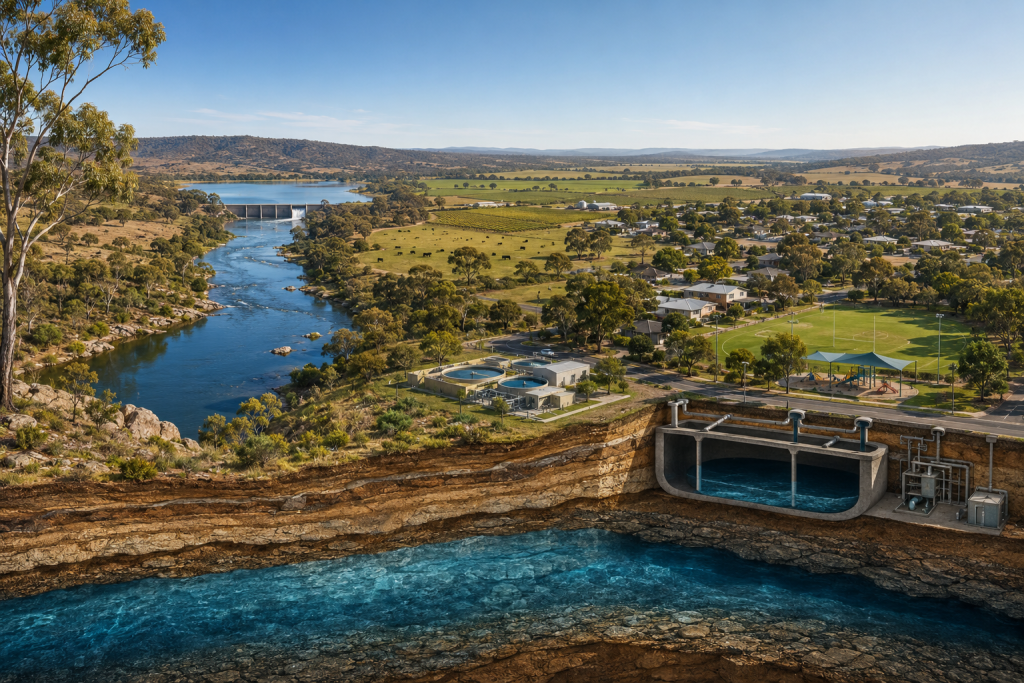
Water policy must include rivers, dams, groundwater, stormwater, recycled water, desalination and carefully assessed water-diversion projects. It must protect essential household supplies while supporting food production, regional communities and responsible economic development.
The FuturePlan would establish a long-term national water strategy based on practical engineering, reliable science, local knowledge, environmental responsibility and direct public oversight.
Water Is Essential National Infrastructure
Every household needs dependable access to clean drinking water, sanitation and wastewater services. These are basic requirements for health, dignity and community stability.
Under the FuturePlan, normal household water, sewage and wastewater services would be progressively funded from General Revenue after the replacement-revenue system described in Step 4 had been proven sufficient and dependable.
This would not provide unlimited free water. Wasteful or exceptional use could still attract a charge. Normal household needs would be protected, while excessive consumption would remain subject to fair controls established with public participation.
Commercial and industrial users would continue to pay the real cost of unusually large water use, specialised treatment and dedicated infrastructure. Households should not be forced to subsidise private operations that consume enormous quantities of water.
A National Water Audit
No country can make sound decisions without knowing how much water is available, where it is located, how quickly it is being used and how reliably each source is replenished.
A National Water Audit would bring together national, regional and local information. The results would be publicly available in clear language, subject only to necessary security protections for critical infrastructure.
The audit would examine:
- dam and reservoir capacity;
- river and stream flows;
- groundwater levels and bore pressure;
- urban stormwater volumes;
- wastewater recycling capacity;
It would also examine:
- desalination capacity;
- leaks and avoidable losses;
- household, agricultural and industrial demand;
- environmental water requirements;
- future population and emergency needs.
Every region would then prepare a practical water plan. National coordination would help connect these plans where rivers, aquifers, pipelines and water users cross political boundaries.
A National Water Capability Test
Before governments approve large developments, they must determine whether the necessary water can be supplied without taking essential water from households, farms, regional towns or the environment.
The test would ask:
- How much water will the project use?
- Where will that water come from?
- Is the source reliably replenished?
- Will other users lose access or face higher costs?
- Could recycled or lower-quality water be used instead?
It would also ask:
- What happens during drought?
- Who pays for new infrastructure?
- How will pollution and wastewater be managed?
- Could the project damage rivers, aquifers, springs or wetlands?
- Can the development operate without weakening national water security?
Protecting Great Underground Water Resources
Many countries hold enormous quantities of water beneath the ground in regional, coastal and inland aquifers. These reserves may support cities, towns, farms, industries, rivers, wetlands, natural springs and culturally important places.
Large groundwater systems can extend beneath several regions, communities and political boundaries. Their size can create the false impression that the water is unlimited, even though recharge may be slow and extraction in one place may affect users and ecosystems far away.
The Great Artesian Basin provides an important Australian case study. It is one of the world’s largest underground water systems and demonstrates both the value of major aquifers and the need for careful measurement, maintenance and long-term protection.
However, the amount stored underground must not be confused with the amount that can be safely taken each year. Some groundwater is extremely old and is replenished very slowly. Water pressure and quality also vary greatly between locations and depths. A large stored volume does not make the Basin an unlimited water tank.
Every country should identify and monitor its significant aquifers. Some recharge relatively quickly after rain, while others may take many decades, centuries or considerably longer to recover.
A National Groundwater Program
The FuturePlan would establish a National Groundwater Program to map, monitor and protect the country’s underground water. It would work with regional governments, local communities, landholders, farmers, Indigenous communities, scientists and existing water authorities.
The program would not take lawful control away from local users and landholders. Its purpose would be to prevent one region or large user from damaging a shared aquifer that may extend beneath several properties, communities or administrative regions.
Mapping and monitoring would include:
- the location, depth and extent of major aquifers;
- groundwater levels and artesian pressure;
- water quality and contamination risks;
- estimated extraction from registered bores;
- recharge areas and estimated replenishment rates.
Protection measures would include:
- registering and maintaining active bores;
- repairing or safely capping abandoned and leaking bores;
- metering substantial commercial extraction;
- regional limits based on safe extraction rates;
- public warnings when water levels, pressure or quality deteriorate.
Monitoring must examine the combined effect of all extraction, not merely assess each bore or project separately. Ten projects may individually appear acceptable while their combined use places the same aquifer under severe pressure.
Protecting Recharge Areas
Groundwater must be replenished wherever practical. Recharge commonly occurs where rainfall, rivers or floodwater soak through suitable soil and rock into an aquifer. If recharge areas are polluted, paved over or badly disturbed, the quantity and quality of underground water may decline.
Important recharge areas would be identified and protected from avoidable contamination. Landholders would not lose lawful use of their property without due process, evidence and fair compensation where a genuine restriction caused a measurable loss.
Managed aquifer recharge could be used where scientific assessment shows it is safe. Treated stormwater, recycled water or surplus floodwater could be allowed to filter into suitable aquifers. Before this occurred, the water would have to meet strict quality requirements and the project would need safeguards against contamination, rising salinity and damage to nearby property.
Protecting Springs, Rivers and Wetlands
Groundwater does not always remain underground. It can feed natural springs, rivers, wetlands and vegetation. Excessive pumping can reduce these flows even when the bore is located many kilometres away.
Some Great Artesian Basin springs support rare species and places of great cultural importance to First Nations peoples. Water planning must therefore account for the connection between underground extraction and the surface environment.
Where monitoring shows that extraction is causing serious damage, new large allocations would be paused and existing use reviewed. Any reduction would be based on verified evidence, regional necessity, lawful rights and fair transition arrangements—not arbitrary government orders.
Fair Priorities During Water Shortages
During severe drought or groundwater decline, essential needs must come before optional and wasteful uses.
- Human survival and public health: Drinking water, sanitation, hospitals and emergency services.
- Essential household use: Reasonable water for cooking, cleaning and normal domestic life.
- Livestock welfare and food production: Water needed to protect animals and maintain essential agricultural production.
- Community and environmental survival: Regional towns, critical springs, rivers, wetlands and ecosystems.
- Commercial and industrial activity: Continued according to necessity, efficiency, available supply and the ability to use alternative water.
These priorities would not allow governments to confiscate water without lawful process. They would guide fair emergency planning established before a crisis occurs.
Mining, Gas and Large Industrial Users
Mining, gas extraction and other major industries can affect underground water through pumping, drilling, depressurisation, contamination or the removal of water produced during extraction.
Approval would require independent assessment of the entire affected groundwater system. Companies would have to establish reliable baseline measurements before work began so that later changes could be identified.
A company that damages an aquifer, bore, spring, wetland or neighbouring water supply would be responsible for monitoring, replacement water, treatment and restoration. These costs must not be transferred to households, farmers or taxpayers.
Financial security could be required before high-risk work begins. This would ensure money remained available for repair and rehabilitation if a company failed, left the country or attempted to avoid its responsibilities.
AI Data Centres and Other Large Water Users
Large data centres can use substantial amounts of water for cooling, either directly at the facility or indirectly through electricity generation. They must not be permitted to quietly compete with nearby households, farmers or towns for limited drinking water or groundwater.
Before approval, a major data centre would be required to disclose its expected annual and peak water use, cooling method, source of supply, drought plan and effect on the local aquifer or water network.
- Preference would be given to air cooling, closed-loop systems, recycled water or other methods that reduce demand for drinking water.
- Groundwater extraction would be permitted only where independent evidence showed it was sustainable.
- The operator would pay the full cost of dedicated water infrastructure, monitoring and treatment.
- Household, hospital, emergency and essential food-production supplies would take priority during a declared shortage.
- Actual water use would be publicly reported and independently checked.
Repairing Leaks and Existing Infrastructure
Before building enormous new projects, governments should stop wasting water through deteriorating pipes, leaking channels, faulty meters and badly maintained equipment.
Water authorities would publish leakage figures and repair plans. The worst losses would be addressed first. Domestic manufacturers and workers would be encouraged to supply pipes, pumps, meters, purification equipment, control systems and replacement parts.
Underground Water Tanks Beneath Local Parks
Large underground water tanks could be installed beneath suitable parks, sporting fields and other public land. These systems would capture stormwater that currently rushes through drains and is often discharged into rivers or the sea.
The park could continue to operate above the tank after construction. Stored water could irrigate the park, supply nearby gardens, wash streets, support firefighting and reduce demand on drinking-water reservoirs.
This approach would not be suitable beneath every park. Each location would require engineering, environmental and financial assessment.
Site assessment would consider:
- the amount and reliability of local stormwater;
- soil, rock and groundwater conditions;
- the risk of flooding or tank movement;
- existing pipes, cables and foundations;
- public access during construction.
The design would consider:
- maintenance and safe inspection access;
- mosquito, odour and contamination control;
- overflow during extreme rain;
- connections to nearby users;
- the cost compared with other local options.
How a Community Stormwater System Would Work
- Capture: Rainwater would enter the normal street-drainage network.
- Initial filtering: Gross-pollutant traps would remove rubbish, leaves and large debris.
- First-flush control: The dirtiest early runoff could be separated or treated more intensively.
- Sediment removal: Sand, soil and smaller particles would settle or be filtered out.
- Storage and distribution: Water would enter a sealed underground tank and be pumped to the appropriate treatment or use.
Initial systems should concentrate on non-drinking uses because these can reduce demand at lower cost and with fewer health risks. Separate, clearly identified pipes could deliver the water for parks, gardens, street cleaning, industrial processes and other approved purposes.
Purifying Captured Water for Drinking
Stormwater can contain fuel, chemicals, metals, bacteria, viruses and other contaminants. It must never be assumed safe merely because it looks clean.
Where local conditions and economics make drinking-water production practical, a dedicated purification plant could use several protective barriers. These could include screening, sedimentation, biological treatment, fine filtration, activated carbon, membrane treatment, ultraviolet disinfection and carefully controlled chlorination.
The exact treatment process would depend on the water entering the system. Water quality would be continuously monitored, independently tested and required to meet the country’s published drinking-water standards before entering a household drinking-water network.
If existing regional treatment plants can purify the captured water more safely and economically, the stored water could be transferred there instead of constructing a small plant beneath every park.
Drinking-water and non-drinking-water pipes must remain physically separated. Automatic controls would prevent unsafe water from entering the drinking supply. If testing failed, distribution would stop immediately.
Local Pilot Projects
The underground-tank proposal should begin with carefully selected pilot neighbourhoods rather than an immediate nationwide rollout.
- Select communities with suitable parks, regular stormwater and identifiable local demand.
- Consult nearby residents, businesses and park users before approval.
- Begin with park irrigation and other non-drinking uses.
- Measure construction costs, energy use, water savings, maintenance and water quality.
- Add drinking-water purification only where the evidence demonstrates safety, reliability and value.
Successful designs could then be adapted for other communities. Unsuccessful or excessively expensive projects would not be repeated simply to protect a political announcement.
Case Study: The Bradfield Scheme
The original Bradfield Scheme was proposed in Australia in 1938 by engineer Dr John Bradfield. It sought to divert water from rivers flowing towards Queensland’s east coast and send it inland across or through the Great Dividing Range.
The broad purpose was to provide inland water, support agriculture and reduce drought pressure. The idea has remained popular because large quantities of rain fall near the coast while inland communities regularly face water shortages.
However, later assessments found serious problems with the original proposal. Early estimates greatly overstated the amount of water likely to be available. Pumping water across high ground would require substantial energy. Long channels and reservoirs would lose water through evaporation and seepage. Construction would also be extremely expensive and could affect rivers, ecosystems, cultural sites and existing water users.
This does not mean that every inland-diversion proposal should be rejected. It means every country should test each possible component on its own merits instead of promising that one enormous project will solve every water problem.
Lessons for a Modern Regional Water Program
FuturePlan would replace all-or-nothing arguments about large diversion schemes with staged regional water programs. In Australia, this could include testing practical components inspired by the Bradfield concept without committing the nation to the entire original scheme. Other countries could apply the same evidence-based approach to their own proposed water-transfer projects.
Every proposal would require:
- updated rainfall and river-flow information;
- honest estimates of dependable water yield;
- full construction and operating costs;
- energy requirements and supply plans;
- evaporation and transmission-loss estimates.
Assessment would also cover:
- environmental and cultural effects;
- existing lawful water rights;
- benefits for towns, farms and industry;
- alternatives such as recycling or groundwater;
- performance during drought and extreme floods.
Possible works could include smaller pipelines, tunnels, off-stream storage, floodwater capture, regional connections and renewable-powered pumping. Water would be diverted only when sufficient flow remained for downstream communities and the environment.
Where suitable aquifers exist, carefully treated surplus floodwater might also be stored underground through managed aquifer recharge. This could reduce evaporation compared with large shallow surface reservoirs. It would proceed only after geological and water-quality testing demonstrated that the aquifer would not be contaminated or damaged.
Recycled Water and Desalination
Water that has already been collected and treated should not be discarded unnecessarily. Properly treated wastewater can supply parks, farms, industry and environmental projects. With sufficiently advanced treatment and strict safeguards, it can also contribute to drinking-water systems.
Desalination provides a rainfall-independent supply for suitable coastal regions. However, it requires substantial energy and produces concentrated brine that must be safely managed. It should form part of a diverse system rather than being treated as the only answer.
Regions would select the safest and most economical combination of groundwater, dams, stormwater, recycling, desalination and transfers. Different communities need different solutions.
Agriculture and Regional Communities
Farmers need reliable water to produce food, care for livestock and keep families on the land. Water policy must therefore help agricultural communities improve security without encouraging waste or making promises that cannot be delivered.
- Support would be available for efficient irrigation, soil-moisture monitoring, on-farm storage and leak repairs.
- Farmers would receive better regional forecasts and clear groundwater information.
- Shared infrastructure could help smaller farms that could not afford major systems alone.
- Water trading and allocation rules would be transparent and protected against manipulation.
- Local experience would be included when governments assess projects and drought responses.
First Nations Knowledge and Cultural Protection
Indigenous communities hold important knowledge about springs, rivers, seasonal water, land and long-term environmental change. This knowledge should inform planning alongside engineering and scientific evidence.
Cultural sites and traditional connections to water must be treated with respect. Consultation must be genuine, but no organisation or government should use consultation as an excuse to hide evidence, avoid public accountability or exclude the wider community from decisions affecting shared national resources.
Protecting Property and Water Rights
Water reform must respect lawful property interests and established water rights. Government should not simply seize land, cancel legitimate rights or force infrastructure onto a property.
Where land or access is genuinely required for essential public infrastructure, the need must be proved, alternatives considered and fair compensation paid. Affected people must have access to an independent review process.
At the same time, no landholder or company can reasonably claim the right to drain or contaminate a shared aquifer merely because a bore is located on private property. A connected water system must be managed with regard for everyone who depends upon it.
Domestic Skills, Manufacturing and Security
A national water program would create long-term work for engineers, scientists, tradespeople, farmers, manufacturers, technicians and regional workers.
Where practical, each country should manufacture and maintain its own pumps, pipes, tanks, filters, meters, membranes, treatment systems and control equipment. Critical water infrastructure must be protected from cyberattack, sabotage, foreign control and unreliable overseas supply chains.
Manual backup systems and emergency parts should remain available. A water network must not become useless because one computer system, foreign supplier or communications network fails.
Public Oversight and Citizen Approval
Major water projects can affect communities for generations and commit enormous amounts of public money. Complete proposals must therefore be published before construction begins.
Citizens would be able to examine the evidence, question officials, compare alternatives and use the FuturePlan participation system to express their views. Projects of exceptional national cost or consequence could be placed before the people through a binding public vote.
Independent audits would report the actual cost, water delivered, environmental results and maintenance condition of each major project. If a project failed to meet its stated objectives, the public would be told plainly.
A Staged National Program
- Measure: Complete the National Water Audit and identify urgent risks, including declining groundwater and leaking infrastructure.
- Protect: Safeguard drinking supplies, recharge areas, aquifers, rivers, springs, wetlands and essential agricultural water.
- Repair: Fix failing pipes, bores, channels, pumps, treatment plants and monitoring systems.
- Test: Begin regional pilots for stormwater storage, purification, recycling, aquifer recharge and efficient irrigation.
- Build: Construct only the projects that pass engineering, financial, environmental and public-interest tests.
Honest Limitations
No water policy can make rainfall certain, eliminate every drought or deliver unlimited water to every location. Groundwater is a vital reserve but cannot be pumped without limits. Large water-diversion concepts may offer useful regional projects, but every component must prove its practicality, cost and environmental value before becoming part of a national solution.
Underground tanks, purification plants, recycling and desalination also have costs and technical limits. The answer is not one grand promise. It is a connected system of carefully selected projects, honest measurement, responsible use and continual public oversight.
The FuturePlan Promise
The FuturePlan would treat water as essential national infrastructure. It would protect normal household needs, help farmers remain productive, require major users to pay their fair costs and prevent shared water resources from being damaged for short-term private gain.
Each country’s rivers, groundwater, dams, stormwater, recycled water and coastal resources would be managed as parts of one national system. Decisions would be based on evidence, openly explained and subject to the continuing authority of the people.
By measuring what is available, protecting it from waste and contamination, and building only what genuinely works, every country can provide secure water for households, farms, industry, regional communities and future generations.